Eva-Lotte

Gerard Genette divides the function of the narrator into the categories voice and mode. Voice = who is speaking? Is the narrator part of the cast of characters (homodiegetic) or not (heterodiegetic)? Furthermore with Genette embedded narratives can be described down to three levels of nesting (intradiegetic, extradiegetic, metadiegetic). In Stanzel's terminology, voice corresponds to auctorial, personal, or first-person narrator. In medieval literature the most common type of narrator, with Genette, is a hetero- and extradiegetic narrator. With Stanzel, it is a usually authorial narrator who is occasionally personal.
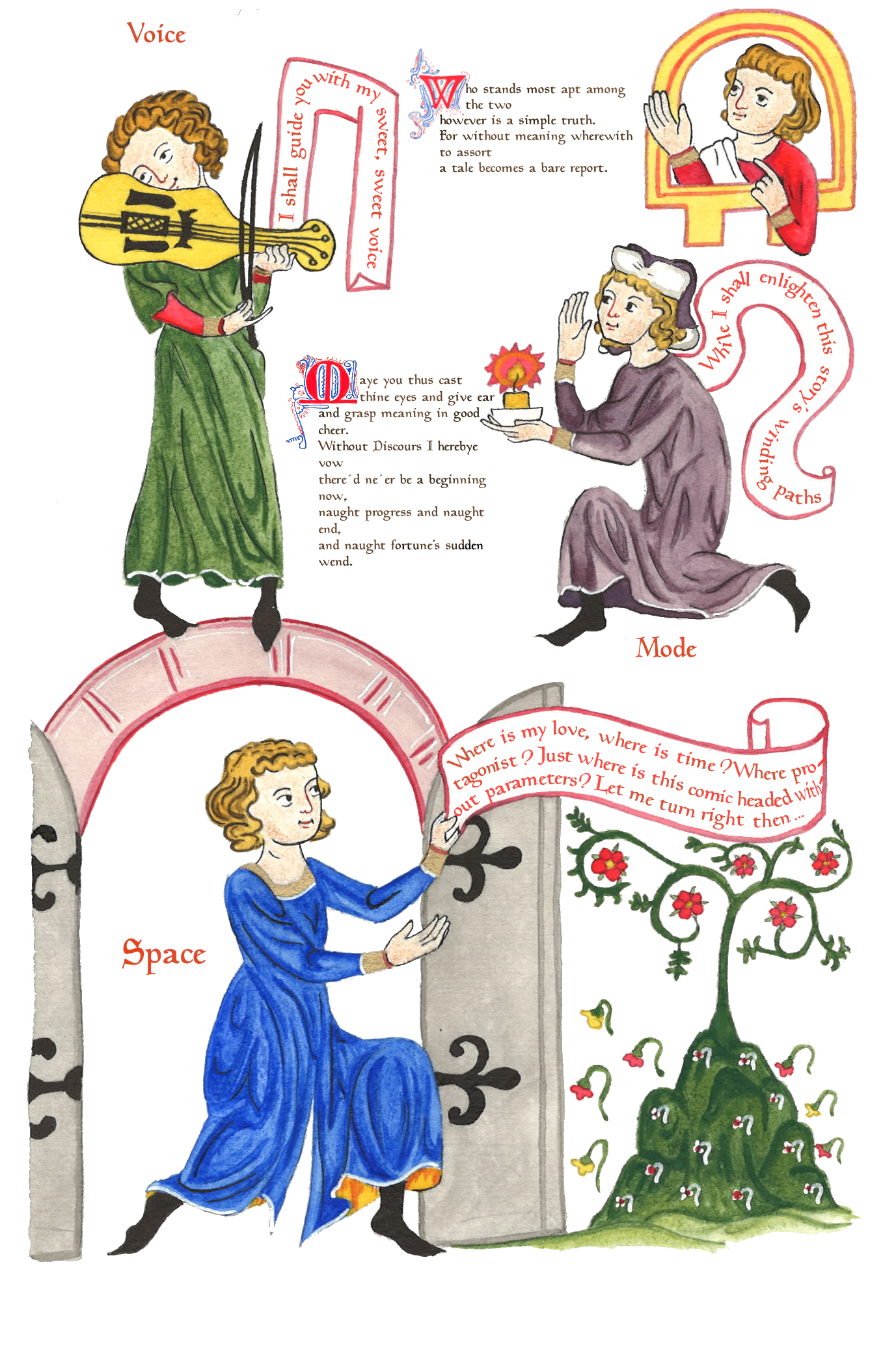
In Genette's terminology, mode encompasses both distance and focalisation. Zero perspective = the perspective of all characters. Internal focalisation = the perspective of a single character. External focalisation = the perspective of no single character. With Genette, the most common type of focalisation in medieval literature is external focalisation with partial zero focalisation.

Space is created by the characters moving through it and is therefore functionally dependent on the requirements of the plot, sometimes without any coherence (e.g. doors that appear when they are needed). Fictional and real geography can coexist, moreover space is often semantically charged – for example, turning left at a crossroads frequently leads to ruin. Medieval literature distinguishes between four basic types of space: Insular spaces, fixed-point spaces, and elastic and non-elastic path spaces.